

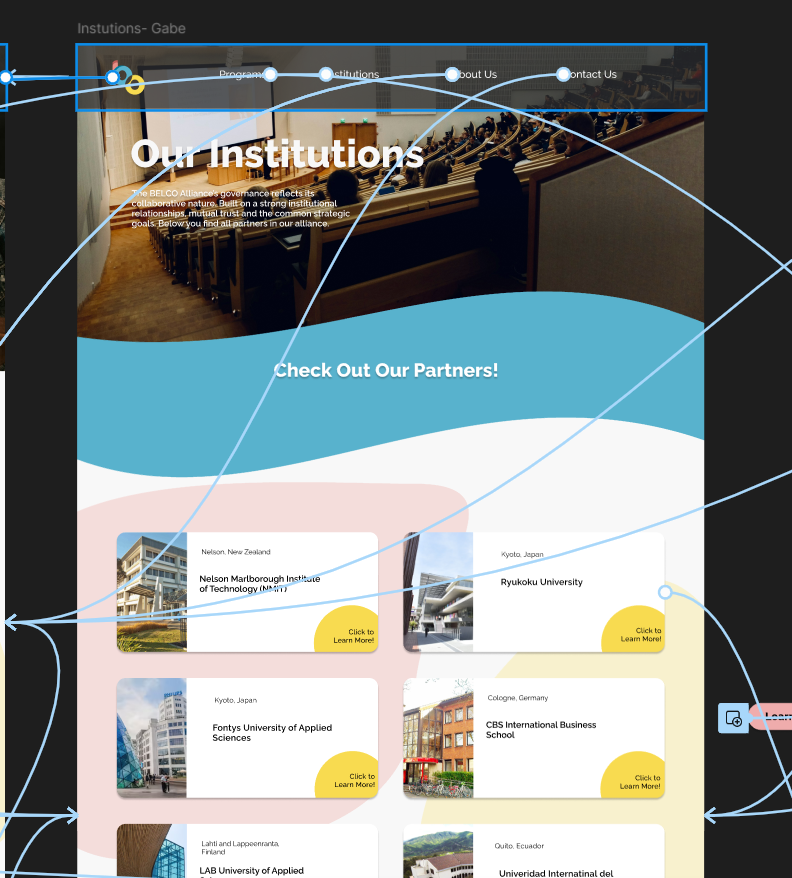
Following the creation of the design for BELCO Alliance & Education, I joined a smaller group to take that design and build it into a website. It was at the beginning of this project that we were given a significant update that BELCO did not want Alliance and Education to be on one website together, which lead the groups being split into two, each group either creating a site for the Education, or Alliance side. My team created the page for BELCO Education.
My main role in this group was to develop the homepage of BELCO Education. This page featured some of the more technically challenging aspects of the website, with eye-catching animations like a slideshow with animation transitions. For this I utilized my own CSS and JavaScript files. On top of this, I also created some shared assets that would be utilized throughout the website, specifically the header and footer.
Due to the change to developing strictly for BELCO Education, naturally, certain things in the previous design needed to be tweaked, edited, or removed. I adapted the homepage accordingly, identifying which sections needed to be removed and how the remaining content could be restructured to balance layout spacing, prevent awkward gaps, and maintain narrative clarity.
In this small group, I found that project communication and organization went significantly better than the previous project. Like the previous project, we had a MS Teams and a Trello, however the difference this time as these tools were used from start to finish of the project, and weren’t forgot about, leaving the group lost and scrambling.
We utilized the Trello to create a checklist with subtasks, where everyone was aware of what tasks they needed to do, and in how much time we should be making progress. With a collaborative development project, we also of course utilized Git, where each of us worked on their own pages, making effective code comments. We all ended up working on the main branch during this project, which thankfully did not end in any merge conflicts, due to proper task division, and individual files, but through feedback we have learned that this is not best practice. Working in sperate branches and only merging when a feature is in a stable state is a strategy I will use in future projects.
Toward the end of development, I revisited the same user I had previously interviewed during the design phase to conduct a functionality and design consistency test. This proved invaluable. They pointed out that the slideshow felt repetitive with too few images, which I addressed immediately by sourcing and integrating more. They also identified broken or misleading links in a different team member’s page. This feedback was passed on to the group to ensure cohesive user experience across the site.